
[ad_1]
Digital currency and virtual digital assets
What are the instruments of Virtual Digital Assets?
- The Finance Bill 2022 defined the term “virtual digital asset” by entering a new clause (47A) under Income Tax
- The definition of virtual digital asset is proposed to mean any information or code or tokens (not Indian currency or any foreign currency) generated through cryptographic means as per the proposed new clause.
Cryptocurrency, by whatever name called, would be considered a virtual digital asset in India, which could be taxed. If it satisfies the following conditions:
- cryptocurrencies in the form of information, codes, numbers or tokens;
- It serves as a digital representation of the value;
- it is generated by cryptographic means or otherwise;
- It has some inherent value; And
- Cryptocurrency allows the storage and transfer of its units or tokens.
Government-issued digital currencies, both foreign and Indian, are specifically excluded from the purview of virtual digital assets as per Budget 2022;
What are the benefits of cryptocurrency?
Some of the benefits of cryptocurrencies are mentioned below:
- While cryptocurrency investments can generate huge profits, the value has skyrocketed over the past few years.
- No involvement of third parties like banks and financial institutions.
- Faster and cheaper money transfers with decentralized systems that do not collapse to a single point of failure.
What are the disadvantages of cryptocurrencies?
Some of the disadvantages of cryptocurrencies are given below:
- Leaves a digital trail that can be used to allow authorities to track financial transactions of individuals.
- Cryptocurrencies include high energy consumption, price volatility, and use in criminal activities for mining activities.
The digital nature provided above, transactions are prone to hacks.
What is the rationale behind taxation in India?
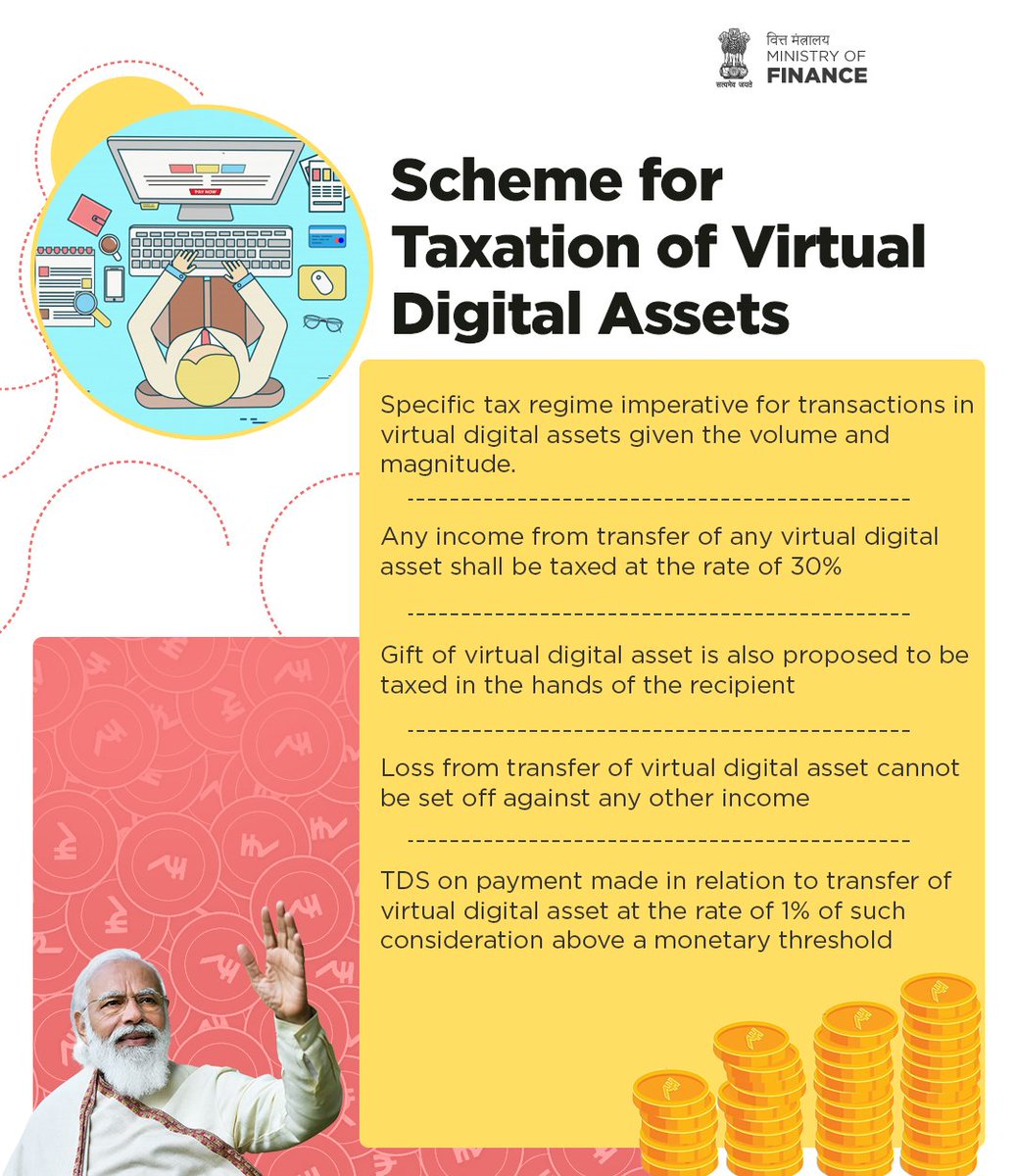
- In recent times, virtual digital assets have grown in popularity, and the trading volume in these assets has increased significantly.
- In addition, a market is being created in which payment for the transfer of one virtual digital asset can be made using another virtual digital asset.
- These considerations require the creation of a specific tax regime.
TDS on Virtual Digital Assets.
- The Finance Minister of India in his Budget 2022 recommended a 30% tax on income from virtual digital assets.
- The Finance Minister recommended 1% plus tax deduction at source (TDS) on payments made in connection with transfer of virtual digital assets.
Providing virtual digital assets as a gift
- Gifts of virtual digital assets will also be taxable, possibly at prices reflected in mainstream indices, or at fair market value or ready reckoner rates determined by the government from time to time.
- But because NFTs are non-fungible by nature, and the value of each token is independent of the value of the other tokens, this approach may not be viable for estimating their value.
Digital Currency of Central Bank of India
- While the Indian government continues to reject cryptocurrencies as legal tender, the Finance Bill recognizes potential applications of blockchain technology and announces India’s own central bank controlled currency (CBDC), as the digital equivalent of the Indian rupee. will work in
- So because the RBI would be the regulator of such a digital currency, it would be different from other cryptocurrencies, which are now decentralized.
How is digital currency different from virtual digital assets?
- Even if it is a crypto, a currency is only a currency if it is issued by a central bank.
- Conversely, anything outside it is referred to by everyone as a cryptocurrency, although it is not a currency.
- These are known as virtual digital assets.
- Non-fungible tokens, commonly known as NFTs, are cryptographic assets on a blockchain that contain unique identification codes and metadata that differentiate them from each other. NFTs can be used to represent people’s identities, property rights, and more.
- This is in contrast to alternative tokens, such as cryptocurrencies, which are similar to each other and can therefore be used as a means of exchange.
- The Indian Finance Minister said that what the Reserve Bank of India will issue in the next financial year will be a digital currency. The above is called Digital Rupee.
[ad_2]
Source link

