
The Section 115BAC New Tax Regime 2025 has redefined the way individuals and HUFs calculate and file their income tax. With simplified slab rates, enhanced standard deductions, and automatic comparison tools, taxpayers can now determine their most beneficial regime effortlessly. This comprehensive guide explores every detail of Section 115BAC of the Income Tax Act, its benefits, limitations, and how you can maximise your tax savings using the Automatic Tax Calculator for the Financial Year 2025–26.

Understanding Section 115BAC – New Tax Regime Overview
Section 115BAC of the Income Tax Act, 1961, introduces an alternative tax structure designed to simplify compliance and reduce tax liability for those not claiming multiple deductions. From FY 2023–24, the new regime became the default tax system. However, taxpayers can still choose the old regime if it proves more beneficial.
Under this provision, individuals can opt between the New or Old Tax Regime annually. If no explicit choice is made, the system automatically applies the New Tax Regime. This flexibility allows taxpayers to strategically plan their finances and minimise tax burdens based on their personal investment and expense profiles.
Eligibility for Section 115BAC
Only individuals and Hindu Undivided Families (HUFs) can file taxes under Section 115BAC. However, to avail of the new regime, the taxpayer must forgo certain deductions and exemptions, including:
- House Rent Allowance (HRA) under Section 10(13A)
- Special allowances under Section 10(14)
- Home loan interest on self-occupied property under Section 24
- Additional depreciation under Section 32
- Scientific research expenses under Section 35
- Most Chapter VI-A deductions, except:
Moreover, taxpayers cannot carry forward losses attributed to these disallowed deductions.
Section 115BAC New Tax Regime Slabs for FY 2025–26
The Union Budget 2025 introduced further relaxed tax slabs to increase the take-home income of salaried individuals. The updated tax regime slab rates are:
| Taxable Income (FY 2025–26) | Tax Rate |
| Up to ₹4,00,000 | NIL |
| ₹4,00,001 – ₹8,00,000 | 5% |
| ₹8,00,001 – ₹12,00,000 | 10% |
| ₹12,00,001 – ₹16,00,000 | 15% |
| ₹16,00,001 – ₹20,00,000 | 20% |
| ₹20,00,001 – ₹24,00,000 | 25% |
| Above ₹24,00,000 | 30% |
By contrast, for FY 2024–25, the tax-free limit was ₹3 lakh, meaning taxpayers now enjoy an additional ₹1 lakh exemption at the lowest slab level.
Rebate and Relief Under Section 87A
Taxpayers under the New Tax Regime (FY 2025–26) receive a rebate of ₹60,000 for taxable income up to ₹7 lakhs, effectively nullifying tax liability. Under the Old Regime, the rebate remains ₹12,500 for income up to ₹5 lakhs.
This enhancement directly benefits middle-income earners and strengthens disposable income.
Comparison Between Old and New Tax Regimes
When comparing both regimes, the New Tax Regime offers lower rates but fewer deductions, while the Old Regime supports tax savings through investments.
| Income Slab | Old Regime Rate | New Regime Rate |
| Up to ₹2.5 L | NIL | NIL |
| ₹2.5 L – ₹5 L | 5% | 5% |
| ₹5 L – ₹10 L | 20% | 10% |
| ₹10 L – ₹15 L | 30% | 20% |
| Above ₹15 L | 30% | 30% |
Therefore, taxpayers with limited deductions or simplified financial structures will benefit significantly under the new system.
Deductions and Exemptions Available Under the New Regime
Although Section 115BAC removes most exemptions, several key deductions remain intact, ensuring fairness across categories:
- Employer’s NPS contribution (Section 80CCD(2)) – Up to 14% of salary for central government employees.
- Deduction for Agniveer Corpus contributions (Section 80CCH(2)).
- Additional employee cost (Section 80JJAA) for new employment generation.
- Standard deduction of ₹75,000 (raised from ₹50,000 in FY 2024–25).
- Exemptions for retirement benefits, such as:
- Gratuity (Section 10(10))
- Leave encashment (Section 10(10AA))
- VRS payments (Section 10(10C))
- Transport and conveyance allowances for specially-abled employees.
- Interest on let-out property (Section 24).
- Family pension deduction (Section 57(iia)) up to ₹25,000 (enhanced in Budget 2024).
Thus, the regime still accommodates essential deductions while eliminating complex exemptions.
Deductions Not Allowed Under the New Tax Regime
The following popular deductions are not available under the new system:
- Section 80C (PPF, ELSS, Life Insurance, etc.)
- Section 80D (Health insurance premium)
- Section 80E (Education loan interest)
- House Rent Allowance (HRA)
- Leave Travel Allowance (LTA)
- Interest on self-occupied property (Section 24)
- Donations (Section 80G)
- Professional tax and entertainment allowance
- Children’s education and hostel allowance
This shift simplifies filing but limits benefits for those with higher tax-saving investments.
Form 10IEA and Switching Between Tax Regimes
The Form 10IEA plays a crucial role in regime selection:
- Salaried employees can choose or switch regimes each year while filing their ITR.
- Business or professional taxpayers can switch only once — once they opt out of the new regime, they cannot revert without filing Form 10IEA again.
- The due date for filing ITR for FY 2024–25 (AY 2025–26) is September 15, 2025, extendable until December 31, 2025 for belated returns.
Therefore, timely submission ensures eligibility for the desired tax regime.
How to Choose the Right Regime for FY 2025–26
When planning for tax optimisation, always:
- Compare both regimes using the Automatic Tax Calculator in Excel.
- Evaluate deductions and exemptions applicable under the old regime.
- Project your annual income and simulate tax liability.
- Use Form 10IEA to finalize your selection before filing.
If you claim minimal deductions, the New Tax Regime will likely save more. However, for those investing in NPS, ELSS, or insurance, the Old Regime still offers higher overall savings.
Illustrative Tax Comparison (FY 2025–26)
| Income (₹) | Old Regime Tax (₹) | New Regime Tax (₹) | Savings (₹) |
| 7,50,000 | 54,600 | 0 | 54,600 |
| 10,00,000 | 1,06,600 | 44,200 | 62,400 |
| 12,50,000 | 1,79,400 | 79,300 | 1,00,100 |
| 15,00,000 | 2,57,400 | 1,30,000 | 1,27,400 |
Clearly, the new regime offers significant tax savings for taxpayers without major deductions.
Key Benefits of Section 115BAC New Tax Regime 2025
- Simplified compliance – fewer forms and calculations.
- Higher standard deduction of ₹75,000.
- Enhanced rebate up to ₹60,000 for middle-class earners.
- Uniform slab structure benefiting salaried and non-salaried individuals.
- Ease of comparison through automatic Excel-based tax calculators.
Together, these benefits make Section 115BAC a powerful reform toward a transparent and equitable taxation system.
Conclusion
The Section 115BAC New Tax Regime 2025 offers taxpayers a strategic choice between simplicity and savings. While it removes most traditional deductions, it compensates through lower tax rates, increased rebates, and standard deductions. For those with limited tax-saving investments, the New Regime clearly outperforms the old.
To determine the most beneficial path, we recommend using the Automatic Income Tax Calculator in Excel for FY 2025–26, which allows you to analyse both regimes side by side and select the one that maximises your take-home income.
Download Automatic Income Tax Preparation Software All-in-One in Excel (F.Y. 2025–26) for Government and Non-Government Employees

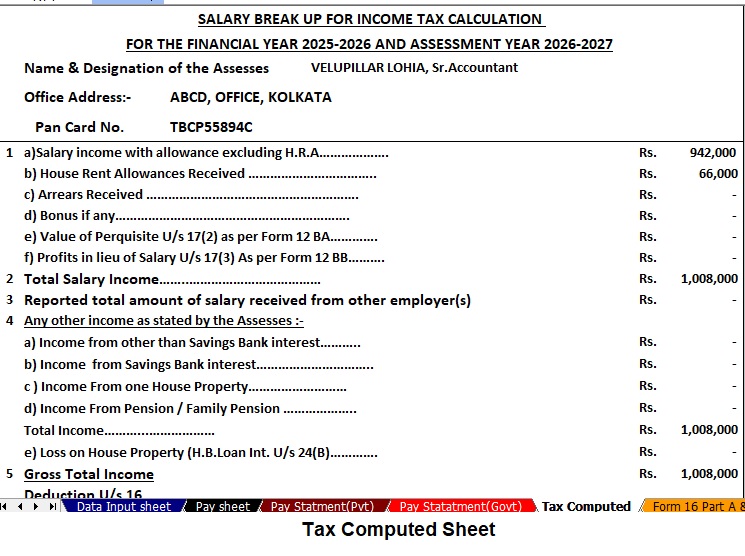


Key Features of the Excel-Based Tax Preparation Utility
- Dual Regime Option:
You can effortlessly choose between the New or Old Tax Regime under Section 115BAC. Furthermore, the tool automatically compares both regimes to help you identify the most tax-saving option. - Customised Salary Structure:
It automatically adjusts according to your salary format, whether you belong to a Government or Non-Government organisation. Additionally, this customisation reduces manual entry and saves valuable time. - Automatic Arrears Relief Calculator [Section 89(1) + Form 10E]:
It accurately calculates arrears relief for the financial years ranging from 2000–01 to 2025–26. In addition, it instantly generates Form 10E for submission, ensuring precise tax relief computations. - Updated Form 16 (Part A & B):
This tool automatically generates Revised Form 16 (Part A & B) for the Financial Year 2025–26. Likewise, it ensures that your Form 16 remains compliant with the latest tax formats. - Simplified Compliance:
It ensures quick and error-free tax computation through advanced built-in formulas. Furthermore, you can confidently prepare your return with zero manual intervention, enhancing both speed and accuracy.

